The 1850 Ljuder Emigration
The EmigrantsThe 1850 Ljuder Emigration is the departure of a varied group of people from Ljuder Parish for North America, a collective movement assembled from private crises rather than a single shared cause. The emigrants sought escape from poverty, debt, religious and civil pressure, constrained work, and unsettled personal lives; they left with only uncertain knowledge of their destination, and the long crossing turned the promise of freedom into a test of endurance.
Background and Motives
The group left Ljuder Parish, in Småland, in 1850, during the period when group migration was the most common form of Swedish emigration. Such groups typically numbered from fifteen to two hundred people and often set out to establish farming or religious settlements. The novel’s emigrants are not united by one motive: crop failure, persecution by civil authorities, religious dissent, personal problems, social ostracism, and unfair employment practices all contribute to the decision to leave. Their shared route therefore gathers separate forms of dissatisfaction into one movement.
The departure emerges against the slow disturbance of rural communities that had long depended on inherited routines and the soil. News and rumors of fertile land across the ocean passed from neighbor to neighbor, while pictures and printed accounts offered possibilities no one in the emigrants’ home community could verify from personal experience. The new country promised tillable soil and greater freedom to people with little land, mounting debts, or few prospects; for others, emigration meant leaving entanglements at home rather than pursuing a guaranteed reward. The ocean and the destination remained unknown, and the choice divided the cautious from those willing to risk the journey.
Household Decisions and Practical Arrangements
For Karl Oskar Nilsson, the decision followed years of worsening circumstances at Korpamoen. After four years of work, he and Kristina were several hundred riksdaler poorer than when they began. He feared that staying would consume their strength without improving their position, leaving them to spend old age in the reserved room with meager bread, as his crippled father and mother did. His argument for departure arose from the prospect of continued labor without a meaningful return.
Kristina did not share his confidence in America. She worried that the attractive reports might prove a wild-goose chase: no authority in the United States had promised the family land, Karl Oskar had no deed awaiting him, and they knew no farmer with wife and children who had already made the journey and could describe the country. She distrusted the newspapers and books on which his hopes rested. Their decision thus required more than agreement about hardship; it required Kristina to face the risk that the destination might not match the picture her husband had formed.
The plans acquired a timetable and a price. Karl Oskar and Robert Nilsson wrote to a firm in Karlshamn and secured a promise of passage aboard the merchant vessel Charlotta. They sent a down payment of one hundred daler for six passengers and expected to embark around the second week of April, sailing directly to New York. Spring offered a practical advantage: the winter storms would have passed, and an early arrival would leave time to till and sow before the fall harvest. Karl Oskar also offered to obtain a passage contract for Danjel Andreasson if the ship had room. Danjel planned to bring nine people from Kärragärde, including children and household members.
The cost of leaving narrowed the family’s prospects even as it enabled the journey. After selling Korpamoen and its contents, and after the mortgage and other debts were deducted, about 1,200 daler remained. Passage for the family—three adults and three children—cost 675 daler, leaving Karl Oskar with about 500 daler before the American entrance fee and onward transport to an unknown settlement. He hoped to obtain land almost free, but little money would remain for livestock and farm tools. To protect their last security, Kristina sewed the 500 daler into a sheepskin bag that Karl Oskar could fasten to his belt and carry against his body.
The Emigrant Party Sets Out
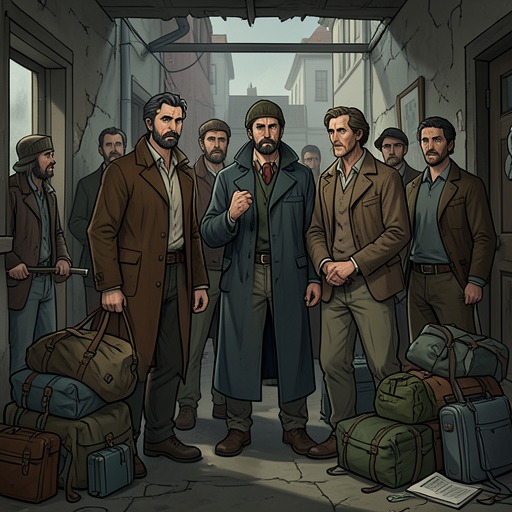
The travelers converged at Åkerby Junction. Danjel came from Kärragärde with his wife, four children, and Ulrika of Västergöhl, riding in a hired team from Kråkesjö. Jonas Petter of Hästebäck drove his own one-horse wagon with a hired man, who was to take the horse back from Karlshamn. Arvid and Elin, unable to fit on Danjel’s wagon, traveled with Jonas Petter. Robert moved from the heavily laden Korpamoen wagon and found a place beside Elin; Arvid welcomed him with a broad grin. The two farmhands from Nybacken, once imagined as escaping secretly and alone, were now journeying together in a visible group.
Nineteen people met at the junction: three drivers who would return from Karlshamn and sixteen emigrants, nine adults and seven children. Jonas Petter remarked that they made a suitably large family and raised the question of who should lead it. The attention turned to Karl Oskar, who demurred because he was the youngest of the three farmers; he addressed Jonas Petter as the oldest. The gathering made the migration’s social structure visible: separate households had been linked by transport, kinship, employment, and shared plans, but the party had not become a single family in any simple sense.
The road itself sharpened the meaning of departure. As the wagons passed familiar places, Karl Oskar and Kristina looked at them in silence: a brook where they had swum, a meadow where they would no longer see spring lilies. The journey began not only as movement toward a new country but as a last passage through the landscape of their youth. Along the route, Robert counted openings in winter pasture fences as gates on the road to America, even where the gates had been removed; had departure been delayed a month, he thought, those openings too would have been closed.
Passage and Arrival
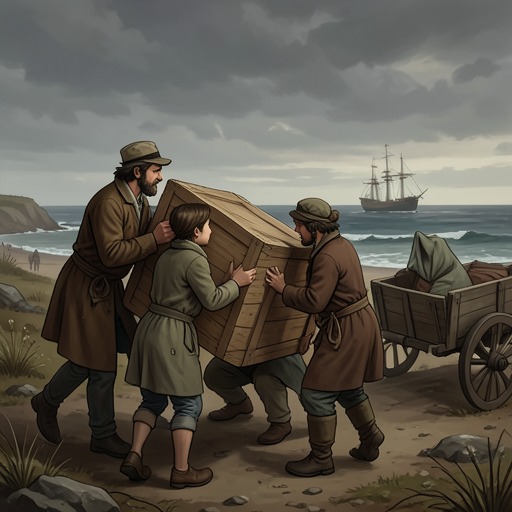
The emigrants’ expectation of a new start collided with the material reality of the sea voyage. The prolonged crossing brought storms, illness, suffering, and confinement aboard ship. Scurvy and ship’s fever weakened the passengers; monotonous days left them depressed, downhearted, and in some cases indifferent to what life might bring. Their arrival was not simply the fulfillment of a plan: it followed a passage that had worn down their bodies and spirits.
When America became visible, passengers gathered on deck, carrying those too weak to climb by themselves. The shore first presented houses, churches, embankments, piers, roads, people, and carriages, but the emigrants searched for something else. They found it in a grove of leafy trees and grass on a point of land: green earth, set against the dark shore they had left at Karlshamn. The sight confirmed that the sea had been crossed and that land lay before them again.
The vision changed the passengers’ condition without erasing the suffering that preceded it. Crowded together on deck, they were compared to cattle confined in narrow stalls through winter and turning toward a doorway at the scent of spring. At the sight of living ground, a new energy and ambition seized them: the sick felt they might recover, the weakened came to life, and initiative and boldness returned to those who had been exhausted or afraid. The arrival thus closes the crossing with renewed possibility, not with proof that the emigrants’ hopes of land, security, or freedom will be fulfilled.